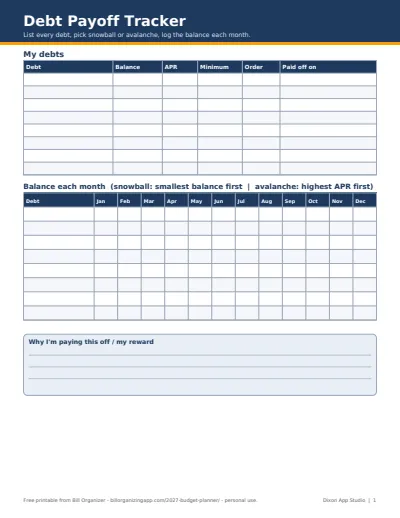
A free debt payoff planner: list up to ten debts with balance, APR and minimum payment, pick snowball or avalanche, and the sheet numbers the order to attack them. Log each month's balance from your statements to watch the total fall. Excel and Google Sheets .xlsx plus a printable PDF, no email.
In the example's five debts ($21,650 in total) the $850 store card comes first either way, because it has both the smallest balance and the highest rate (26.99%). After it, snowball moves to the $1,300 medical bill and avalanche to the 22.49% credit card. For your debt-free date and the interest each method costs, run your numbers through the debt snowball calculator.
Debt payoff tracker
Up to 10 debts, snowball or avalanche order at the flip of a dropdown, and a balance log for every month of the year.
The .xlsx opens in Excel, Apple Numbers and LibreOffice. For Google Sheets: drive.google.com → New → File upload → open the file → File → Save as Google Sheets. Type in the cream cells; totals update by themselves.
Snowball or avalanche?
Both methods pay the minimum on every debt and put every extra dollar on one target. When it's paid off, its payment rolls onto the next. The difference is the order:
Snowball wins on motivation, avalanche on math. In the pack's 2027 example (five debts, $890 a month), both finish in April 2029 and avalanche saves about $225 of interest; with bigger, higher-rate balances the gap grows. Pick the one you'll stick with.
Snowball: smallest balance first. Quick wins keep you going.
Avalanche: highest interest rate first. Least interest overall.
Find the extra money
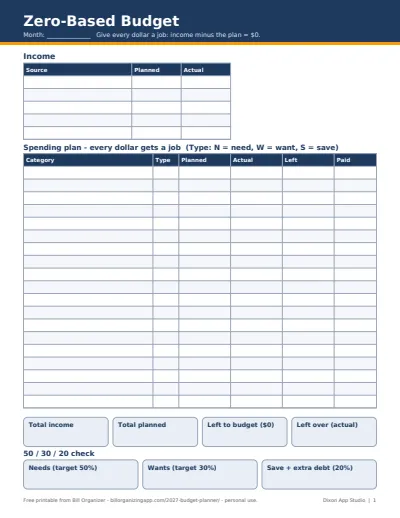
Every extra $50 a month moves the debt-free date. Look for it in the 50/30/20 budget template (wants above 30%), cancelled subscriptions, or a tax refund: estimate yours with the tax refund estimator. For a single card, the credit card payoff calculator shows months and interest; to compare rolling the debts into one loan, try the debt consolidation calculator. If you'd rather have it all connected, the paid 2027 Budget Planner Spreadsheet Pack (below) links twelve dated months, sinking funds, debt payoff and a bill calendar into one workbook; the free files here stay free either way.
Plan the new year
How to make a budget: seven steps from take-home pay to a finished plan, with example numbers
Avalanche (highest APR first) costs the least interest. Snowball (smallest balance first) pays off the first debt sooner, which helps many people keep going. The best one is the one you'll finish.
How do I make a debt payoff plan?
List every debt with its balance, APR and minimum; decide how much you can pay in total each month; pay minimums on all and the extra on the first debt in your chosen order; roll each paid-off payment into the next.
Is there a free debt payoff planner for Google Sheets?
Yes: download the free .xlsx tracker, upload it to Google Drive and choose File → Save as Google Sheets. The order switches between snowball and avalanche with one dropdown.
Should I save or pay off debt first?
Most plans keep a small emergency fund first so a surprise doesn't go on a card, then attack high-interest debt. The invest or pay off debt calculator compares the two for your rates.
How do I track debt payoff progress?
Write each debt's balance from your statement once a month. The tracker totals them and shows the percentage paid off for each debt.
Prefer paper? Bill organizers and budget planners
#ad · Amazon
As an Amazon Associate I earn from qualifying purchases.