
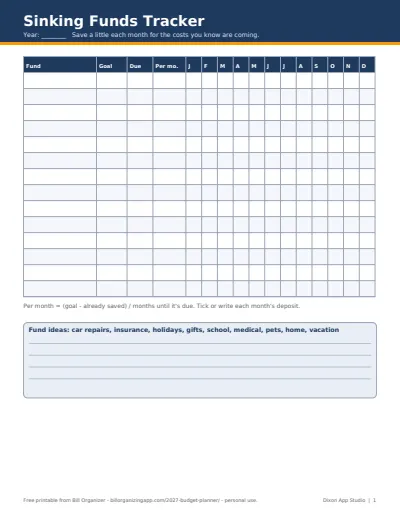
How sinking funds work
A sinking fund is money set aside a little at a time for a cost with a date: the yearly car insurance, holiday gifts, a vacation, property tax. Divide the goal (minus what you've already saved) by the months until it's due, and save that every month. When the bill arrives, the money is there, and it never lands on a credit card.
Keep the money in one high-yield savings account and let the tracker say how much belongs to each fund, or use separate savings 'buckets' if your bank offers them. Add the monthly total as one line in your budget.
- Yearly bills: car registration, insurance, memberships, property tax, software renewals.
- Irregular but certain: car repairs, medical and dental, pet care, home maintenance.
- Seasonal: holidays and gifts, back to school, summer camp, vacations.
Work out the monthly amount
The sinking fund calculator does the same math for one goal, and the yearly expenses calculator helps find the costs to plan for. For the gift fund, the holiday budget calculator splits the total by person. If you'd rather have it all connected, the paid 2027 Budget Planner Spreadsheet Pack (below) links twelve dated months, sinking funds, debt payoff and a bill calendar into one workbook; the free files here stay free either way.
Plan the new year
- How to make a budget: seven steps from take-home pay to a finished plan, with example numbers
- New year money reset checklist: 20 steps to review 2026 and set up 2027
- January bills to expect: renewals, property tax, holiday card balances and estimated tax
More of the 2027 budget pack
- 2027 Budget Planner Template (Free Excel & Google Sheets): all four free templates and how to set up your 2027 budget in an hour
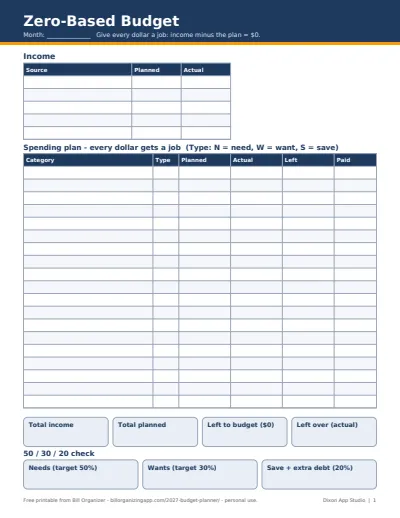
- Zero-Based Budget Template (Free Excel, Google Sheets & PDF): give every dollar a job until income minus the plan is $0
- 50/30/20 Budget Template (Free Excel, Google Sheets & PDF): needs 50%, wants 30%, savings 20%, in dollars and against your real plan
- Debt Payoff Planner (Free Snowball & Avalanche Tracker): snowball or avalanche order and a monthly balance log for up to 10 debts